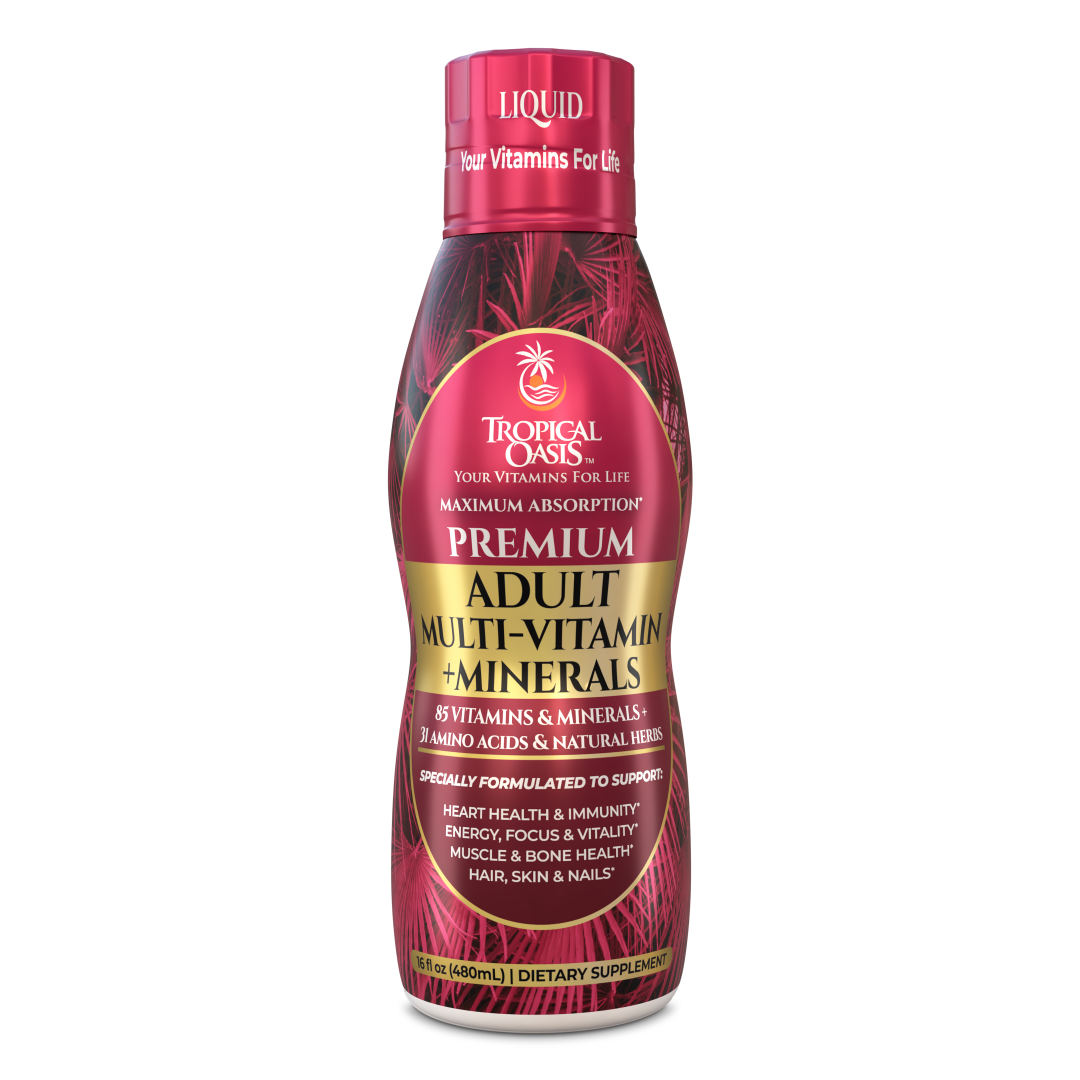
Women's Premium Liquid Multivitamin: Who It's For

This article is for general wellness and educational purposes. It isn’t medical advice, and it doesn’t diagnose, treat, cure, or prevent any disease.
Most women don’t go looking for a multivitamin because something is dramatically wrong. They go looking because of the small stuff: the 3 p.m. slump that shows up every single afternoon, the hair in the shower drain, the nagging sense that dinner was a handful of crackers and whatever the kids didn’t finish. A daily multivitamin isn’t a fix for any of that on its own — but it is a reasonable way to put a floor under a diet that isn’t always perfect.
That’s the job the Women’s Premium Liquid Multivitamin is built to do. Here’s an honest look at who it’s actually for, what it covers, and how to fit it into a real week.
Why a women’s formula in the first place?
“Women’s” on a label isn’t just marketing paint. Nutrient needs genuinely differ across the population, and a few of those differences are well established in the nutrition literature.
- Iron. Menstruating women lose iron monthly, and iron needs during those years are meaningfully higher than for adult men. After menopause, the gap narrows considerably.
- Calcium and vitamin D. Bone density tends to decline more sharply for women after menopause, so nutrients that support bone health get more attention in women’s formulas.
- Folate. Adequate folate matters for anyone, and it’s especially emphasized during the childbearing years.
- Antioxidant vitamins. Vitamins A, C, and E can support skin, hair, and general cellular health — areas women often say they’re paying attention to.
A women’s formula simply weights the blend toward that profile instead of offering one generic dose for everyone.
Who it’s a good fit for
The busy-schedule eater
If your meals are governed by whatever the day allows — coffee at 7, something at your desk at noon, a rushed dinner — you’re the clearest candidate. You’re not eating badly on purpose. You’re eating around a calendar. A daily multi is insurance against the gaps that creates.
Anyone who can’t stand swallowing pills
This is a bigger group than people admit. Pill aversion is common, and a supplement you dread taking is a supplement you stop taking by week three. A liquid sidesteps the issue entirely — it’s a spoonful, not a negotiation.
Women in life transitions
Perimenopause, postpartum, a new training routine, a stretch of poor sleep — periods when the body’s demands shift are exactly when a consistent nutritional baseline is most useful. It won’t carry you through a hard season, but it can keep one variable steady.
People restricting a food group
Plant-based, dairy-free, gluten-free, low-calorie — every restriction removes a food, and every food carries nutrients. A multi helps backfill what’s no longer on the plate.
Who probably doesn’t need it
Being straight about this builds more trust than overselling. You may not need a general multivitamin if you already eat a varied, produce-heavy diet and your bloodwork looks good; if your healthcare provider has you on targeted, higher-dose single nutrients and adding a multi risks stacking doses; or if you’re looking for a solution to a specific symptom, in which case testing beats guessing. A multivitamin is a broad, low-drama foundation — not a targeted intervention.
Why liquid changes the daily experience
The absorption conversation gets a lot of airtime, and it’s a real one — a liquid arrives already dissolved, skipping the disintegration step a compressed tablet has to complete before anything is available to the body. But the more practical advantage is simpler: liquids are easier to actually take every day.
Consistency is the whole game with a multivitamin. The nutrients in one dose aren’t doing dramatic work in isolation; the value accrues from a steady daily baseline over weeks and months. A format you don’t resist is a format you keep up with. Liquid also makes dose adjustment straightforward — you measure what the label calls for rather than splitting a tablet.
How to work it into your day
A few practical notes:
- Take it with food. Vitamins A, D, E, and K are fat-soluble, so a meal containing some fat — eggs, avocado, olive oil, yogurt — is a sensible pairing.
- Anchor it to something you already do. Next to the coffee maker, beside the toothbrush, in the cabinet you open at breakfast. Habits attach best to existing habits.
- Refrigerate after opening if the label says so, and keep it out of direct sunlight and heat.
- Give it a fair run. Judge it over a couple of months of consistent use, not a couple of days.
- Watch for overlap. If you already take a standalone vitamin D or iron supplement, check the totals so you’re not doubling up unintentionally.
Pairing it with the rest of your routine
A multivitamin sits underneath a routine rather than replacing parts of it. Some women pair it with a collagen supplement if skin, hair, and joint support are the priority, or keep a separate mineral product on hand for a specific need their provider has flagged. If you share a household with someone using a different formula, you can compare the full range at the Tropical Oasis shop and pick what matches each person’s actual situation instead of buying two of the same thing.
What it doesn’t replace: sleep, protein, vegetables, movement, and water. No formula outperforms those. A multivitamin is a small, cheap, low-effort layer of consistency on top — which is exactly why it’s worth being unglamorous about. The nutrients you take reliably are worth more than the ones you take enthusiastically for nine days.
The short version
The Women’s Premium Liquid Multivitamin is for the woman whose diet is decent but inconsistent, who wants nutrient coverage weighted toward the profile women commonly need more of, and who would rather measure a spoonful than fight a horse pill every morning. If that’s a reasonable description of your mornings, it’s an easy thing to try — and an easy thing to keep up.
Always follow label directions. If you’re pregnant or nursing, taking medications, or managing a health condition, check with your healthcare professional before starting a new supplement.